
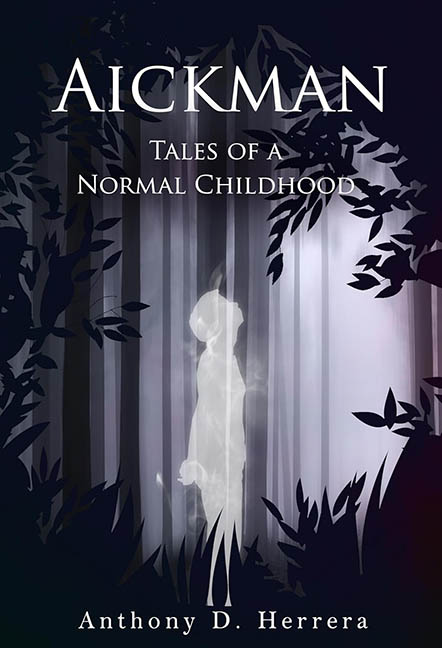
Let’s take a gentle walk through the shadowy woods of cover design crimes, where we stumble upon Aickman: Tales of a Normal Childhood — a title that screams “everyday nostalgia,” yet the cover whispers “paranormal therapy session in a haunted foliage simulator.”
At first glance, the vibe is “ghost child lost in the Adobe Illustrator wilderness.” The ghostly silhouette, presumably our titular Aickman, hovers in the center like a lost Sims character who wandered into a mist filter. The semi-transparent figure is so poorly integrated, you can practically hear the “feather edge: 250px” setting weeping in the background. This isn’t spectral — it’s spectral clip art. The lighting doesn’t match, the shadows are imaginary, and the figure looks like it was gently pasted in using the psychic powers of someone halfway through a YouTube tutorial titled “How to Make Your First Paranormal Cover in 5 Easy Steps (Badly).”
But let’s talk typography — because someone clearly didn’t. The title “AICKMAN” is enormous and styled like it’s the headliner of a vampire opera, while “Tales of a Normal Childhood” limps in beneath it in a completely different, underwhelming serif. The fonts have zero relationship with one another, as if one arrived dressed for a gothic funeral and the other came straight from a corporate HR training manual. Typography isn’t just inconsistent here — it’s a hostage situation.
Now, the background. We have a vector forest that looks like it was cobbled together from five free foliage packs and a Pinterest mood board titled “Spooky Vibes, No Budget.” The composition lacks depth, relying heavily on gradient beams of light that scream “I just discovered the linear gradient tool and I’m not afraid to overuse it.” The trees don’t cast believable shadows, and the whole thing feels like a community theatre backdrop for A Midsummer Night’s Séance.
And let’s not forget the tonal dissonance. “Tales of a Normal Childhood” sounds like it should feature bicycles, scraped knees, and maybe a pet turtle. But this cover is giving “paranormal visitation in the woods where your childhood memories go to die.” The contrast between the cozy-sounding subtitle and the terrifying forest ghost is like putting a clown on the cover of Moby-Dick.
In conclusion, Aickman: Tales of a Normal Childhood is not so much a cover as it is an unresolved artistic identity crisis. It’s trying to be deep, dark, and literary, but lands squarely in the uncanny valley of desktop publishing misadventure. A tale of a “normal childhood”? Maybe — if your normal childhood involved haunted forests, ghost glitches, and a typeface intervention waiting to happen.