
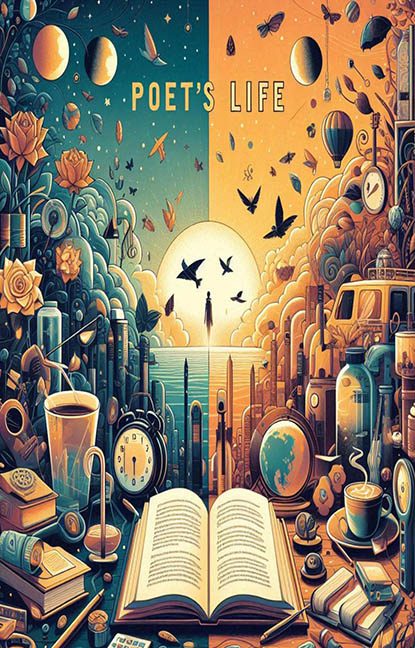
This cover looks like creativity lost a bar fight with perspective and woke up taped to a wall covered in unrelated objects. Poet’s Life isn’t a visual poem—it’s a conglomeration of crap, aggressively assembled and stretched until meaning taps out.
At first glance, it tries to sell itself as whimsical, symbolic, maybe even profound. But give it more than two seconds and the illusion collapses. What you’re left with is chaos unleashed and left unsupervised. There is no direction, no hierarchy, no compositional logic—just an avalanche of “poetic” objects dumped onto the page like someone yelled ART! and hit render.
The split-colour concept—cool blues on one side, warm golds on the other—could have been a strong foundation. Instead, it becomes a fault line where visual sense goes to die. Both halves are equally overcrowded, equally noisy, and equally committed to doing absolutely nothing to guide the viewer’s eye. The symmetry doesn’t calm the chaos; it doubles it.
Let’s talk about the objects. Clocks. Coffee cups. Planets. Rockets. Books. Pens. Teacups. Globes. Hot air balloons. Headphones. Cars. Butterflies. Bottles. Typewriters. Why? Because poets, apparently. This isn’t symbolism—it’s a keyword dump. Nothing is prioritized, nothing is framed, and nothing is allowed to matter more than anything else. When everything is important, nothing is.
The perspective is a crime scene. The open book at the bottom is warped and stretched like it’s sliding into another reality, dragging the rest of the cover with it. Objects don’t sit on surfaces; they float, lean, stack, and collide in ways that ignore gravity, scale, and common sense. It’s not dreamlike—it’s careless. This is what happens when “surreal” is used as a substitute for composition.
The title placement is the final insult. “Poet’s Life” is timidly perched at the top, small and detached, like it’s embarrassed to be associated with what’s happening below. The font choice is bland and underpowered, offering no contrast or authority. It doesn’t anchor the chaos—it gets swallowed by it.
This cover feels less like intentional maximalism and more like AI-assisted indecision. A machine (or a human thinking like one) was asked to visualize creativity and responded by throwing every cultural shorthand for “artsy” into a blender. The result isn’t layered—it’s loud. It’s not expressive—it’s exhausting.
Verdict: Poet’s Life isn’t a visual metaphor; it’s visual noise pretending to be depth. This isn’t the life of a poet—it’s the desktop of someone who never learned to delete files.