
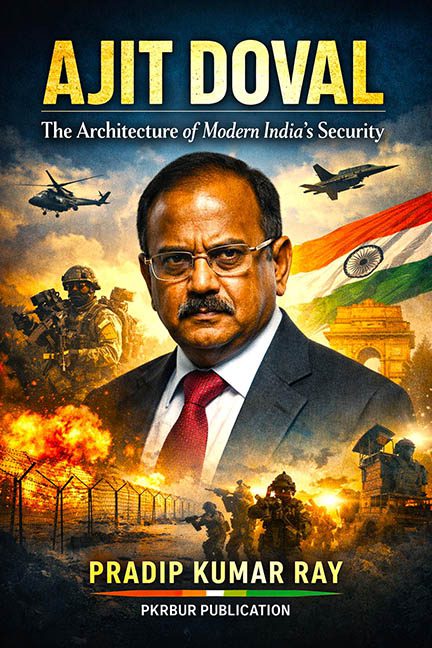
There’s dramatic. There’s intense. And then there’s “Did Michael Bay design this book cover?” Ajit Doval: The Architecture of Modern India’s Security by Pradip Kumar Ray takes a serious nonfiction subject—India’s national security advisor—and dresses it up like the explosive poster for a straight-to-DVD military thriller. Subtle? Not even a little.
The first thing that hits you is the cinematic colour palette. Orange fireball explosions, deep shadowy blues, and that telltale yellow-orange glow used exclusively in action movie trailers and energy drink branding. It’s less “geopolitical analysis” and more “Geopolitical Annihilation: The Final Reckoning.”
Front and centre, we have Ajit Doval himself, glowering into the lens like he’s about to brief a black-ops team before their mission to rescue hostages from a secret Himalayan bunker. His headshot is solid—until you notice the lighting doesn’t match the background at all. It’s pasted in front of a collage of everything vaguely related to security, with the subtlety of a missile strike.
Let’s tally up the Photoshop buffet:
-
Apache helicopters? Check.
-
Fighter jets? Double check.
-
Armed soldiers storming the wire fence? Naturally.
-
Explosions, a border fence, the Indian flag dramatically rippling over India Gate? All present and accounted for.
-
A temple silhouette just to cover the spiritual-patriotic checkbox? You bet.
This isn’t a book cover. It’s a graphic design disaster relief zone. Nothing breathes. Nothing blends. It’s like the designer played Call of Duty with the opacity slider.
And the typography?
AJIT DOVAL roars from the top in bold, distressed movie-poster yellow. The subtitle—“The Architecture of Modern India’s Security”—tries to salvage some dignity in a polite serif, quietly being drowned out by the flames. Meanwhile, the author’s name, Pradip Kumar Ray, is in a matching yellow block, like he’s a co-star in a buddy cop film. Down below: “PKRBUR PUBLICATION” in case you weren’t already confused about who thought this was a good idea.
The result is a cover that screams “intelligence ops thriller”, when it should be whispering “detailed insight into India’s strategic defense policy.” This is a book that probably discusses real-world threats, diplomacy, surveillance, and strategy—yet the cover is ready for a slow-motion shot of Doval walking away from an explosion without looking back.
In conclusion, Ajit Doval didn’t get a cover—he got a visual security breach. This is what happens when you try to turn a policy architect into an action figure. It’s overdesigned, off-message, and absolutely ready to be declassified into the archives of design fails.