
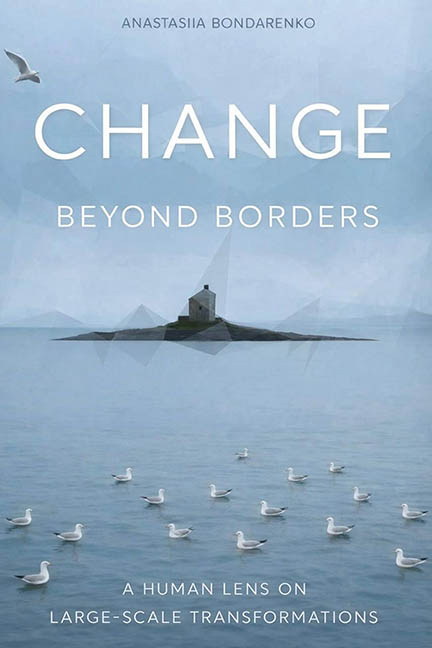
From afar, this cover whispers calm. Serene blue palette, gentle seagulls, a lonely house on a remote islet—it looks like the literary equivalent of a mindfulness app loading screen. But take a closer look, and suddenly you’re not in a meditative landscape; you’re trapped in a low-poly fever dream. Welcome to Change Beyond Borders, where the biggest transformation is from design concept to digital disaster.
Let’s start with the elephant in the ocean: the inexplicable polygonal overlays that stretch across the sky and over the island like visual lint. They look like someone got trigger-happy with the “abstract background” setting and forgot to turn it off. The triangles don’t enhance the composition, don’t symbolize anything, and certainly don’t belong in what’s otherwise a photographic scene. They hover awkwardly in the sky like the ghost of Microsoft Publisher trying to find relevance.
These translucent geometry blobs break the illusion completely. What could have been a clean, elegant cover turns into a confusing half-rendered vector experiment. It’s like the designer tried to merge National Geographic with Tron and just gave up halfway through. The serene setting is hijacked by pointless polygonal clutter, like someone spilled a math problem onto a painting.
And speaking of confused decisions—what is this image trying to tell us? The subtitle boasts “A human lens on large-scale transformations,” but the only transformation happening here is from “peaceful island escape” to “accidental clip-art overlay.” Are the triangles supposed to represent transformation? Migration? Origami folding itself into philosophical metaphors? If so, they forgot the part where symbolism actually makes sense.
Now let’s glide over to the typography. It’s not offensive, but it’s doing the bare minimum. “CHANGE” gets the all-caps treatment in a default sans serif so neutral it might as well be in witness protection. “BEYOND BORDERS” floats beneath it with all the personality of a placeholder slide in a graduate policy presentation. It’s safe, but not in a good way—it’s safely forgettable.
The overall composition is technically symmetrical, but visually unbalanced thanks to the chaos bubbling just beneath the surface—like the cover itself is suppressing a design panic attack. It wants to be sophisticated. It wants to be conceptual. But those polygons are the visual equivalent of an unexpected PowerPoint transition during a TED Talk on climate change: unhelpful, unnecessary, and weirdly distracting.
This isn’t minimalist—it’s minimalism’s awkward cousin who shows up wearing a geometry-themed windbreaker. The birds deserve better. The island deserves better. And frankly, the reader deserves better.
Verdict: If this is change beyond borders, let’s start by putting a firm border around the polygon tool and throwing away the key.