
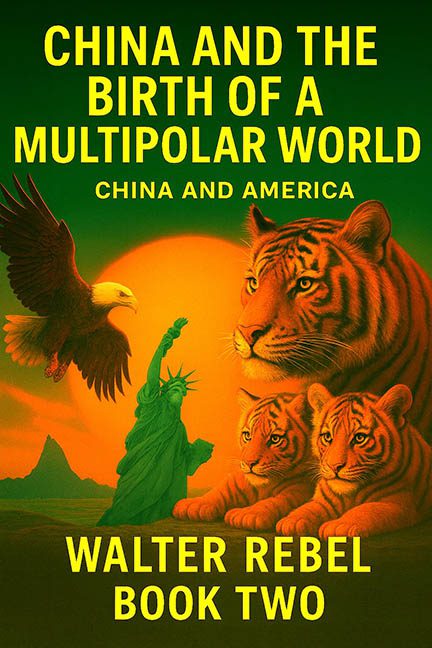
If international diplomacy could be summed up in one wildly unhinged collage, it would be China and the Birth of a Multipolar World by Walter Rebel. This is Book Two, apparently—though it looks less like a sequel and more like the fever dream of someone who fell asleep watching a National Geographic documentary dubbed over by an action movie trailer.
Let’s start with the design’s visual strategy—maximum symbolism, minimum cohesion. Front and centre, we have a family of tigers (presumably representing China), lounging like they just finished filming a soft jazz album cover. Behind them? A glowing orange sun, radiating so much nuclear tension it could double as a Doomsday Clock.
Then there’s the Statue of Liberty. You know her, you love her, and here she is awkwardly floating in front of the sun like she wandered into the wrong genre. She’s there, she’s green, and she’s pointing directly at the tigers as if to say, “What exactly am I doing here?”
But wait—there’s more. Enter: the bald eagle, soaring in from the left with all the subtlety of a screaming midterm election ad. It’s a Photoshop paste job so jarring, you can almost hear the eagle screech “FREEDOM!” as it dive-bombs into this political jungle of design confusion.
And just when you think the chaos is complete—the typography kicks in.
-
CHINA AND THE BIRTH OF A MULTIPOLAR WORLD — huge, bold, in radioactive yellow.
-
CHINA AND AMERICA — smaller, but still demanding attention like a second subtitle that didn’t RSVP.
-
WALTER REBEL BOOK TWO — is this a nonfiction series or the second installment in a geopolitical buddy-cop thriller?
There’s no hierarchy here—just headline anarchy. Everything is shouting at once, like a panel of news anchors trying to speak over each other during a global crisis.
Let’s also talk colour: green and orange, in such searing saturation that it could double as military camo for a cyberpunk rainforest. The contrast is cranked to eleven. The tigers glow. The eagle glows. Even Lady Liberty seems mildly radioactive. This isn’t a colour palette—it’s a warning label.
And what is the genre, exactly? A scholarly take on international relations? A political manifesto? A wildlife-themed Cold War allegory? The cover doesn’t commit—it throws everything onto the table like a graphic design buffet of national metaphors and says, “You figure it out.”
Conclusion:
China and the Birth of a Multipolar World isn’t a book cover—it’s a diplomatic breakdown rendered in clipart. The symbolism is bludgeoning, the design choices are bonkers, and the only thing multipolar here is the layout’s mood disorder.
This isn’t a power shift. It’s a graphic design coup.