
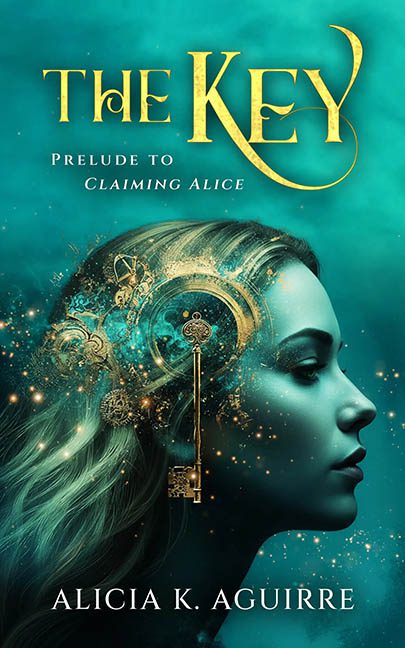
Every once in a while, a book cover floats across our desk looking like it was generated in a steampunk fever dream — and The Key by Alicia K. Aguirre is exactly that dream, only someone forgot to wake up and finish the design.
Let’s begin with the key — the actual, literal key — which is awkwardly plunked over the woman’s head like a giant golden hairpin made by a clockmaker on absinthe. It’s not embedded, not stylized, not even shadowed — it’s just there, floating like an object you’d click on in a bad point-and-click mystery game. The swirling gears and magical sparkles try to pass as “whimsy,” but end up feeling more like someone spilled a steampunk filter pack across a digital painting and called it a day.
Our cover model, tragically, has been AI’d into oblivion. Her face is unnaturally smooth, with a glassy, doll-like perfection that screams, “I’ve never been in the same room as a real human skull.” The hair starts out promising enough, but then disintegrates into smoky noodles and golden dandruff. There are particles. There are floating specks. There are light bursts and swirlies. None of them belong. All of them are everywhere.
Typography? Oh, we’ve got typography. The title font thinks it’s starring in a royal decree. That “Y” is more of a question mark: Why? The subtitle, “Prelude to Claiming Alice,” is so faint, so misplaced, it reads like a whispered threat from the publishing void. Claiming Alice? Who’s Alice? What are we claiming? Why is this key lodged in someone’s temporal lobe?
The background is a gradient teal fog with mystery sparkles — the default mood board for “generic fantasy romance.” There’s no scene, no setting, no world. Just teal. Always teal. And yet… the cover manages to feel both too much and not enough at the same time.
This cover is what happens when design decisions are made by feeding tropes into a fantasy blender and pressing “purée.” It’s technically competent in the way wallpaper is: decorative, inoffensive at a glance, and completely forgettable the moment you walk away.
In the end, The Key doesn’t unlock anything — not intrigue, not genre clarity, and certainly not good design. It simply jiggles around in a lock of confusion, waiting for someone to return with actual art direction.
Better luck next series, Alice.