
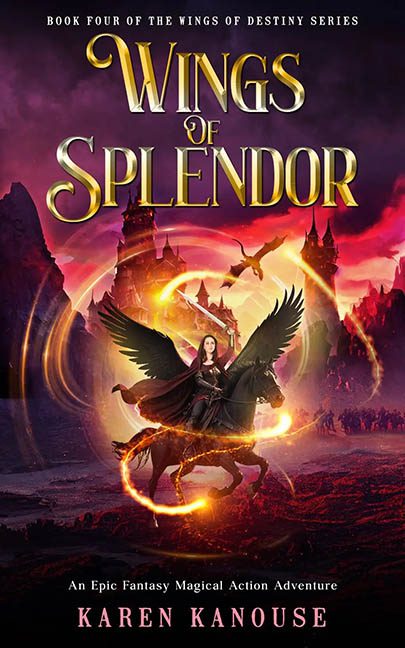
There’s epic fantasy, and then there’s Wings of Splendor, a cover that appears to have mistaken quantity for quality and spectacle for design. This isn’t a scene so much as a visual traffic jam, where every fantasy cliché showed up early, stayed late, and refused to carpool.
Front and centre, we have a winged rider on a horse, encircled by flaming magical rings that look less like sorcery and more like someone discovering the glow slider for the first time. The rider, the horse, the wings, and the fire all exist in slightly different realities, none of them agreeing on where the light source is or what time of day it might be. The flames don’t illuminate the rider. The rider doesn’t cast meaningful shadows. The glow sits politely on top of everything like a decorative sticker, never once interacting with the forms beneath it.
The wings deserve special mention. They appear to be bolted onto the rider’s back as an afterthought, sprouting with no anatomical logic or structural support. They’re decorative wings, not functional ones, the kind you’d expect to see clipped onto a costume rack rather than attached to a living body. The horse, meanwhile, gallops heroically while its rider sits with the relaxed posture of someone on a carousel, blissfully unaffected by physics, momentum, or balance.
Then there’s the background, which contains approximately every fantasy environment available for licensing. Jagged mountains, gothic castles, armies massing in the distance, ominous skies, fiery horizons, flying creatures, and atmospheric haze all compete for attention. Nothing recedes. Nothing leads the eye. It’s all important, which means none of it is. This is less worldbuilding and more world dumping.
Typography attempts to bring order, but only adds to the excess. The gold serif title gleams loudly against an already saturated backdrop, while the subtitle helpfully explains that this is “An Epic Fantasy Magical Action Adventure,” in case the wings, fire, horse, and apocalypse somehow weren’t enough of a clue. It’s the design equivalent of shouting your genre at the reader just to be safe.
The overall effect is that of a video game loading screen frozen mid-explosion. Every asset is polished individually, but together they form a glossy, overprocessed collage with no restraint. This isn’t epic fantasy; it’s fantasy maximalism, where subtlety was exiled early in the design process.
In the end, Wings of Splendor doesn’t fail because it lacks ambition. It fails because it has too much of it and no editor. It wants to be grand, powerful, and awe-inspiring, but instead it becomes a glowing reminder that epic doesn’t come from piling everything into one image. Sometimes, the most magical act in design is knowing when to stop.